Risk to Renewal is Growth MindED Consulting’s turnaround framework for charter school boards and heads of school. It helps you understand where your school stands, determine what needs to change, and organize the work ahead of your next charter review.
The work begins with a review of your school’s academic results and organizational health. From there, I work with your board and school leader to establish priorities, assign responsibilities, and develop a plan for reviewing progress.
A board chair and a head of school can review the same results and reach different conclusions about what the school needs.
The board chair may see a difficult year that the school is prepared to recover from. The head of school may be concerned about changes that began earlier: more teachers leaving, fewer families returning, or a budget that depends on funding available for only one year.
Those differences matter because they affect decisions about staffing, spending, and the support the school needs. Before the board can approve a plan, the board and school leader need a shared understanding of the concerns, their causes, and what the school can reasonably address.
Risk to Renewal provides a structured process for reaching that understanding and deciding what to do next.
Words used on this page
Word
What it means here
Authorizer
The public body that approved the charter, monitors the school, and decides whether the charter continues. In DC, the authorizer is the DC Public Charter School Board.
Charter review
The authorizer’s formal look at a school’s results, which can lead to renewal, conditions, or closure. In DC, each school is reviewed at least every five years.
Renewal
The authorizer’s decision to let a charter school continue operating for another term.
Turnaround
The condition defined in the next section, in which the charter is at risk and the school’s current approach is unlikely to reverse the decline in time.
Renewal Readiness Diagnostic
A structured assessment that rates the school in six areas of school life and names its status level.
Status level
One of five ratings the diagnostic gives a school: Stable, Early Warning, Decline, Intervention Needed, or Critical.
Path
The board’s choice of how to respond: an internal turnaround, a partnered turnaround or restart with another operator, or a planned transition such as a merger.
Phase
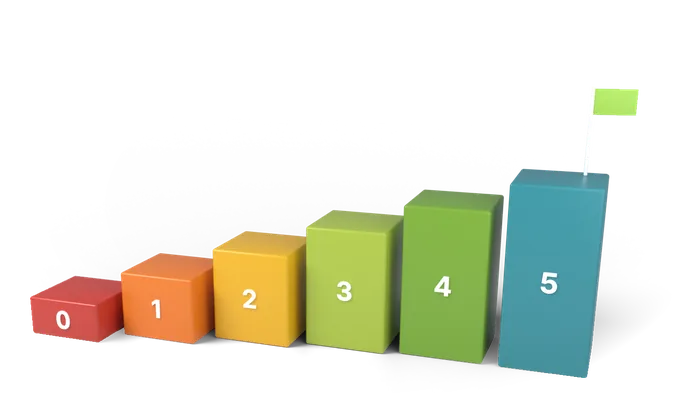
One of six stages of the plan, numbered 0 through 5. Each phase has written expectations for when it is complete.
Core system
A routine the school runs on a set schedule, such as weekly classroom observation and feedback.
First version of a system
The drafted system the school trains staff on before the year begins: its written tools, its time on the schedule, its owner, and the success criteria that show it is working.
Master schedule
The school’s weekly plan of classes and meetings, which must set aside time for coaching, planning, data meetings, and student support.
Owner
The one named person responsible for making sure a priority or system happens on schedule and for reporting on it.
Dashboard
A one-page set of measures, such as attendance and re-enrollment, that the board reviews each month.
Recurring funds
Money the school receives every year, such as per-student funding, as opposed to a grant that ends.
Chronic absence
Missing 10 percent or more of the school days a student is enrolled.
Percentage point
The difference between two percentages. A rate that moves from 40 percent to 27 percent has fallen by 13 percentage points.
Re-enrollment
The share of eligible students who return to the school the next year.
Teacher retention
The share of teachers who return to the school the next year.
Truancy
Unexcused absence from school.
Outside management organization
A company a charter board contracts to run the school day to day.
What Risk to Renewal is
Risk to Renewal guides a charter school board and head of school through the decisions and implementation work involved in school turnaround. It begins with an assessment of the school’s current condition and continues through the work needed to improve results and document progress for renewal.
Within this framework, turnaround describes a school whose academic results or organizational health put its charter at risk and whose current approach is unlikely to reverse the decline within the time available. Both conditions matter. A difficult year alone does not establish that a school needs turnaround support.
The framework uses three questions to distinguish an isolated setback from a pattern that requires a different approach.
Question
What we examine
Risk
Could the school face charter conditions, probation, revocation, or financial difficulty within the next 24 months?
Trend
Have several measures declined for two or more years across more than one area of the school?
Capacity
Can the current leadership, staff, and systems reverse that decline without a substantial change in approach?
School leaders may already understand which practices need to improve. The challenge is organizing that work alongside the daily responsibilities of running a school.
Risk to Renewal establishes who is responsible for each priority, when the work will happen, and what must be in place before a phase is complete.
The six phases
The framework includes six phases, numbered 0 through 5: Diagnose, Organize, Stabilize, Build, Strengthen, and Sustain.
Each phase prepares the school for the next, although some work can happen at the same time. Completion depends on meeting the written expectations for the phase.
Phase
Focus
What happens
Timing
0. Diagnose
Rate the school and choose the path.
The leadership team completes the Renewal Readiness Diagnostic. The board reviews the results, votes on a path, and shares the plan with the authorizer.
January to March of the year before the turnaround year
1. Organize
The leader, the team, and the first version of every core system.
The board confirms the leader and signs a short written agreement on who decides what. The leader names an owner for each priority and reviews every staff role. The team drafts the first version of each core system, with its rubrics, calendars, and success criteria, and builds a master schedule that gives every system its time, so July training uses the systems staff will run.
March to July
2. Stabilize
Student culture, attendance, adult culture, and operations.
Adults teach a small set of schoolwide routines, respond to student behavior the same way, call home for every absence, and give every staff member regular feedback. The first version of each core system runs in simple form to protect the culture.
August to mid-November, the first 90 days of the school year
3. Build
The eight core systems, each with an owner, a set schedule, and a follow-up.
The leadership team puts each of the eight core systems listed below into regular use, confirms it runs as designed, and adjusts it based on evidence, moving each system from its first version to its second.
Mid-November to June of Year 1
4. Strengthen
Deepen instruction, grow leaders, and build the evidence.
Teaching deepens, other leaders take ownership of systems, and the school builds the evidence its authorizer will review.
Year 2
5. Sustain
Make the gains outlast the turnaround.
Every system receives a short written guide and a backup owner, its costs move to recurring funds, and the board votes to close the turnaround when the evidence supports that decision.
Late Year 2 into Year 3
The core systems are drafted in the spring and summer, before staff return. Schools that turned around successfully had their leader in place early, hired staff in the spring, and finished core documents over the summer. A school that waits to build its systems during the school year finds that the schedule has no time for them.
The sequence accounts for the conditions that support improvement. Teachers need predictable routines and consistent support to strengthen their practice. Students need to attend regularly to benefit from that instruction. The school also needs dependable staffing, financial planning, and leadership processes to continue the work from one year to the next.
The eight core systems
Risk to Renewal organizes implementation around eight core systems. For each system, the plan identifies the person responsible, the schedule for completing the work, and how leaders will determine whether it is helping.
Core system
What it addresses
Talent and performance management
The school establishes clear staff expectations and connects hiring, development, and performance reviews to those expectations.
Observation and coaching
Leaders use classroom observations to provide feedback, support teacher practice, and follow up on progress.
Curriculum and planning
Teachers receive guidance and support to plan instruction using the school’s curriculum and students’ learning needs.
Data and intervention
Teams review student data, determine the support students need, and assess whether that support is helping.
Student culture and attendance
Staff establish consistent expectations and routines, respond to student needs, and address barriers to attendance.
Family engagement and re-enrollment
The school maintains communication with families, responds to concerns, and supports decisions about returning the following year.
Operations and finance
Leaders organize daily operations and financial planning to support the school’s priorities and continued operation.
Leadership team and board reporting
School leaders and the board receive the information they need to assess progress, make decisions, and follow up on agreed responsibilities.
For schools serving PreK students, the Instructional Support Accelerator (ISA) can support teaching and learning in PreK classrooms as part of the larger plan.
Start with the Renewal Readiness Diagnostic
Every Risk to Renewal engagement begins with the Renewal Readiness Diagnostic, the first step in Phase 0.
Your leadership team and I review two to three years of data across six areas:
Academic results show how students are performing and whether their learning is improving.
Student culture and attendance data help us understand students’ experiences and participation in school.
Adult culture and talent data help us examine staffing, retention, and staff experiences.
Enrollment and family demand data show whether families are choosing the school and returning.
Finance and operations data help us assess the school’s ability to support its current commitments.
Governance and leadership information helps us examine how decisions are made and how the board and school leadership follow through.
We also visit classrooms, review student work, and hold conversations with staff, students, families, and board members.
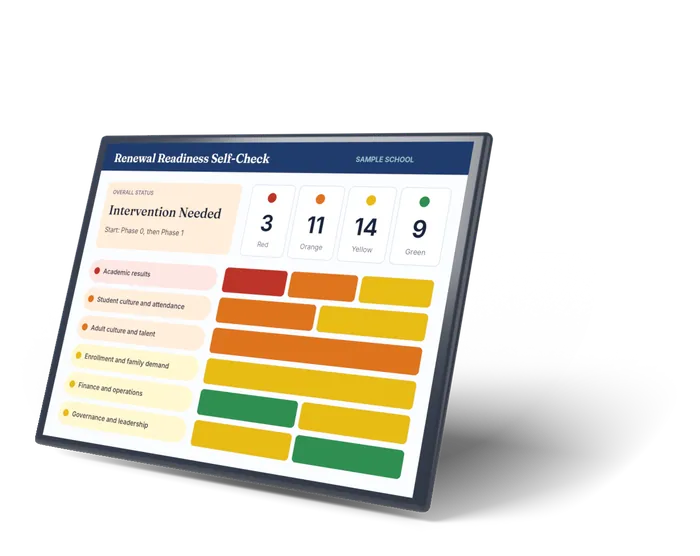
Each area receives a color rating: green, yellow, orange, or red. The ratings appear together on a one-page dashboard, so the board can see at a glance where the school is strong and where it needs attention. For each area rated orange or red, we identify the root cause, and no more than three root causes become the priorities for Phase 1.
A sample dashboard. Each school’s ratings come from its own data, classroom visits, and conversations.
Your board receives a written status report and a presentation explaining the findings and recommended next steps. The diagnostic takes about three weeks. Phase 0 takes six to ten weeks overall, including the board’s review and vote on how to proceed.
The diagnostic uses five status levels: Stable, Early Warning, Decline, Intervention Needed, and Critical.
Status level
What it means
What comes next
Stable
Results and organizational health meet expectations, and systems run with owners.
The board reviews a short dashboard each quarter.
Early Warning
One or two areas show warning signs, or one measure has declined for two years.
The head of school writes a short improvement plan for the affected areas, and the board reviews it monthly.
Decline
Several areas show warning signs and the trend question is met, but the charter is not yet at risk.
This is the best time to act, because the cost of acting is lowest. The board asks for a review of the school’s core systems and acts before the next charter review.
Intervention Needed
The risk and trend questions are both met, and the current approach is unlikely to reverse the decline in time.
The board votes on a path and adopts a turnaround resolution, a formal vote that names the priorities, the dashboard, and the head of school’s authority. The school then moves into Phase 1.
Critical
The charter faces revocation, probation, or financial difficulty within 12 months.
The board decides quickly which path to take and keeps the authorizer informed.
How this saves you time
The diagnostic brings academic, attendance, staffing, enrollment, financial, and leadership information into one written report. Your board can review how the findings relate to one another and use that analysis to make decisions.
Each of the six areas is rated separately. The ratings are never averaged into one score, because an overall score could obscure a concern that needs attention. For example, strong academic results do not resolve a staffing or enrollment problem that may affect the school’s future performance.
When to begin
January through March, before the school year in which turnaround work will begin, is the recommended planning period. Starting then allows the findings to inform hiring, budgeting, and re-enrollment decisions for the following year.
A school already under review can also begin. The diagnostic helps identify which work needs immediate attention and how to organize the remaining phases around the time available.
The Renewal Readiness Diagnostic is $9,500 for one school. Work involving additional campuses is priced in the written scope.
Who Risk to Renewal is for
Risk to Renewal is designed for board chairs and heads of school at single-site charter schools and small charter networks. It fits a school when:
Your school is preparing for a charter review within the next 12 to 24 months.
Your charter includes conditions or a required minimum level of performance.
Your school has a federal improvement designation.
Your school is under financial monitoring.
A board that has noticed early concerns can also begin with the diagnostic alone. The findings help determine whether the school needs focused improvements or a broader turnaround plan.
How we share responsibility
The board is responsible for overseeing the turnaround and approving the decisions within its authority. The head of school leads implementation with the school’s staff. Growth MindED supports both in organizing the work, reviewing progress, and addressing concerns as they arise.
Who
Responsible for
Leaves to others
The board
The board is responsible for the charter, the turnaround resolution, the choice of leader, the dashboard, the budget, and the relationship with the authorizer.
The board does not direct staff or manage daily operations.
The head of school
The head of school is responsible for the turnaround plan, the leadership team, decisions about staff, the weekly meeting schedule, and open reporting to the board.
The head of school does not personally run every system. The head of school makes sure each system has an owner who runs it.
Growth MindED
I lead the diagnostic, meet with the head of school each week, design the systems with your team, provide the tools, and train your staff to run them.
I do not become the person the school cannot function without. Financial restructuring, such as cash forecasting and cost reduction, comes from a partner firm that specializes in charter finance.
From the first month, I plan for your team to manage the work independently. The goal is for your staff to run each system by the end of Year 2 and continue without my ongoing support in Year 3. We review their readiness throughout the engagement so that the transition is planned and supported.
Risk to Renewal is an independent Growth MindED framework. It works alongside your authorizer’s improvement requirements and any improvement plan your school must submit. Those requirements remain in effect throughout the engagement.
The experience behind Risk to Renewal
I developed Risk to Renewal from 25 years of leading schools, principals, and leadership teams in Washington, DC. That experience includes supporting a school through recovery, preparing campuses for charter review, and leading a school recognized for its academic performance.
As interim head of a PreK to 8 charter school serving about 500 students, I led the first year of recovery after the school reached its lowest recorded performance. Over a two-year period, chronic absence fell by about 13 percentage points, truancy declined, and enrollment increased. The school also transitioned from an outside management organization to independent operation under a permanent leader.
As regional vice president overseeing three elementary charter campuses serving more than 1,000 students, I led work that increased teacher retention by 17.5 percentage points and student re-enrollment by 20 percentage points within one semester, ahead of a charter review.
Earlier, as a principal, I led an elementary charter campus to National Blue Ribbon recognition. I later supervised elementary principals across a network of high-performing campuses.
Risk to Renewal draws on that experience and published research on charter and district school turnaround. The full framework includes the sources that inform its approach.
Would 15 minutes be worth a conversation?
We can use the first conversation to discuss your school’s current situation, its charter review timeline, and whether the Renewal Readiness Diagnostic would be a useful starting point.
If the diagnostic appears to fit your needs, we schedule a 30-minute scoping call to clarify the work. Within two business days of that call, I send you a written scope for review.